
How Membranes
Produce Clean Water
Reverse osmosis has emerged as the backbone of water purification processes around the world. From
the water you use from the tap to drink in coastal towns, to the highly purified water used in various
factories, the water that people consume today has been filtered through a membrane process. It is
highly efficient, easily scalable and works very well to transform water that is of poor quality to a
useful commodity. This is how it works.
From osmosis to reverse osmosis
To get started with the concept of reverse osmosis, first let us look at the simple process of osmosis. If
there exists a semi-permeable membrane that divides fresh water from saline water, the water
molecules will move from fresh water to saline water in order to balance the concentrations. This
force exerted by the water is termed osmotic pressure.
Reverse osmosis (RO) does exactly what the name suggests: it reverses that flow. By applying
pressure to the salty side greater than the osmotic pressure, water is forced the other way through the
membrane and away from the dissolved salts. The result is clean water on one side and a concentrated
salt stream on the other.
How reverse osmosis works
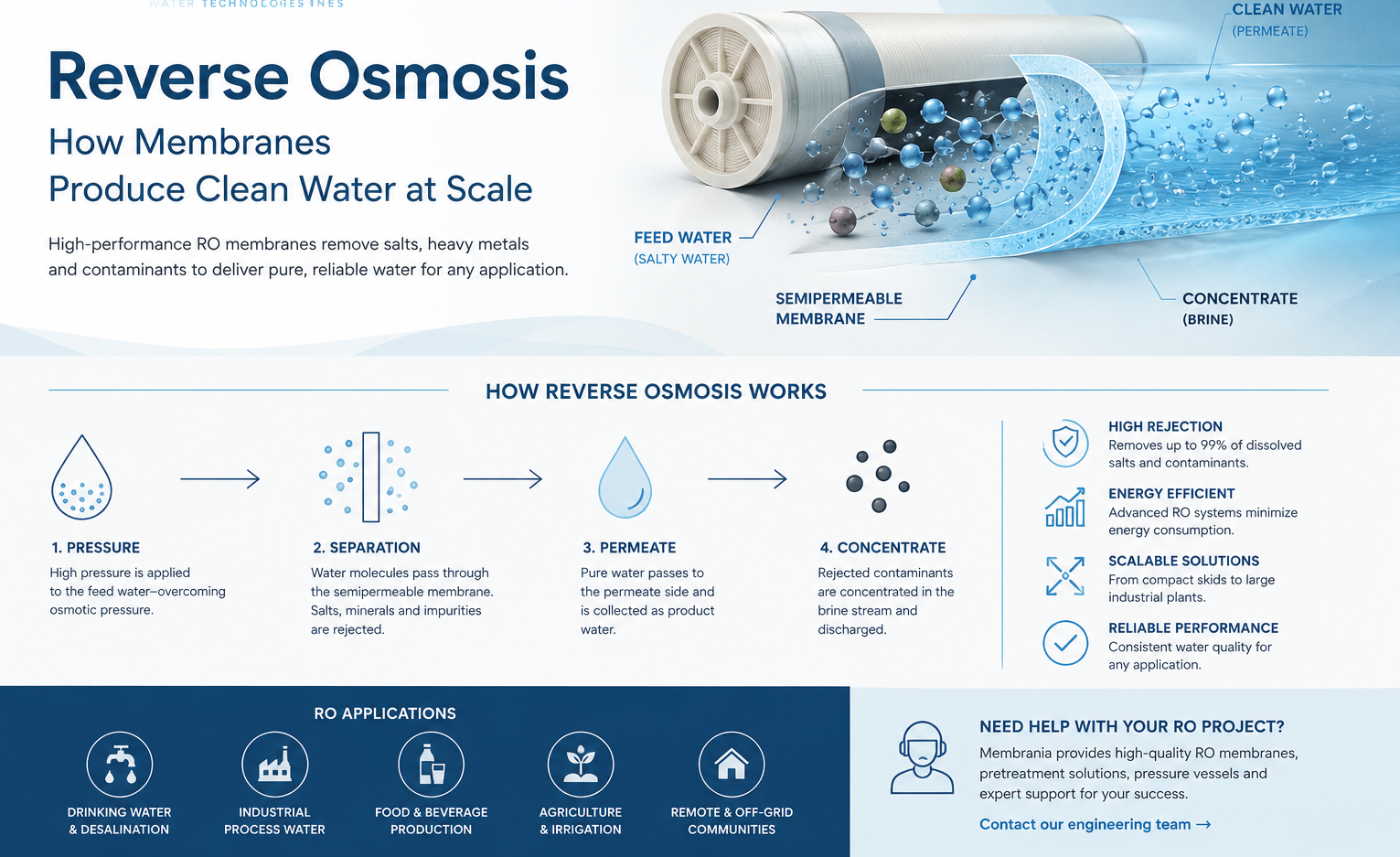
In every RO plant, there is a membrane. In today's membranes, there is an active layer that is
extremely selective, along with a number of supporting porous layers that make up the spiral
membrane element, wrapped around a permeate tube. Pressure forces water molecules across the
active layer, where they get through, leaving ions behind.
This method results in two streams of water. One stream is the permeate that becomes product water.
The other is the concentrate or the brine, which includes all ions and larger pollutants that were not
able to penetrate. The pressure is dependent on the salinity of the feed. Brackish water requires 10–25
bar, and seawater, with much higher osmotic pressure, 55–80 bar.
Salt rejection in current membranes is 99 % or more, which explains why a single pass makes
brackish and even seawater drinkable.
What reverse osmosis removes
The RO process is extremely efficient when dealing with an unusually wide range of pollutants due to
the fact that the separation process takes place on the molecular scale. The process eliminates salts,minerals, heavy metals, nitrates, and almost all organic compounds, in addition to particles, colloids
and microbes which are much bigger than the ions being rejected. This is why RO is useful not only in
desalination, but also in the production of water of high purity.
System components and pretreatment
A reliable RO installation is more than a stack of membranes. Several elements work together:
- Pressure vessels house the spiral-wound elements and safely contain operating pressure.
- High-pressure pumps supply the energy that drives separation.
- Energy recovery devices, used especially in seawater plants, capture energy from the
pressurised brine and return it to the feed, dramatically cutting power consumption.
- Instrumentation and controls track flow, pressure and conductivity so operators can
hold output quality steady.
Just as important is pretreatment. Membranes are precise components, and they will foul or scale if
fed dirty water. Ultrafiltration and microfiltration remove particles and microorganisms, cartridge
filters act as a final guard, and antiscalants and pH adjustment keep sparingly soluble salts from
crystallising on the membrane surface. Good pretreatment is the single biggest factor in long, stable
membrane life.
Where reverse osmosis is used
The versatility of RO is reflected in how widely it is deployed:
- Drinking water and desalination, turning brackish wells and seawater into municipal
supply.
- Industrial process water and boiler feed, where even small amounts of salt cause scaling
and corrosion.
- Food and beverage production, where consistent low-mineral water underpins product
quality, including specialised duties such as dealcoholization of wine and beer.
- Agriculture and remote communities, where brackish water is often the only available
source.
In each case the underlying principle is the same a semipermeable membrane doing the separation
while the membrane choice, recovery target and system design are tailored to the application.
The advantages of reverse osmosis
RO has become the default for good reason:
- Energy efficiency. Pressurising water costs far less energy than boiling it, especially for
brackish feeds, and energy recovery pushes seawater efficiency higher still.
- High, consistent quality. Modern membranes deliver reliable, repeatable rejection across
continuous operation.
- Scalability. Capacity grows simply by adding elements and vessels, from compact skids
to large plants.
- Compact footprint. Systems run at ambient temperature, quietly and in a relatively small
space.
The trade-off is the need for proper pretreatment and membrane care but with good design, that is a
manageable and well-understood requirement.
Choosing the right membranes
RO performance is highly dependent on the choice of the proper membrane for the task. Use of a
brackish membrane on a seawater feed or the opposite will result in bad rejection, high energy
consumption or even early failure of the membrane. Membranes should be selected based on
compatibility with the feed water and the desired recovery and quality.
How Membrania can help
Membrania's strength lies in reverse osmosis, offering brackish and seawater reverse osmosis
membranes from renowned brands, as well as ultrafiltration technology used in pre-treatment,
pressure vessels, and our experience in assembling all these components into one reliable package.
Another type of membranes offered by Membrania include special purpose membranes, like the
BrewFlow membrane, which is designed to dealcoholize beer and wine. The proper membrane is what
makes water treatment possible starting from a small brackish well to a complex industrial facility.
Need help choosing the right RO membrane?
Membrania supplies brackish water and seawater reverse osmosis membranes, ultrafiltration systems, pressure vessels, and technical support for industrial projects.
→ Contact our engineering team.